.svg)
View all articles
Politics
Analysis of college voting behavior, program efficacy, and opportunities to increase student voter participation in the 2025 election cycle.
July 14, 2026
Lorem ipsum dolor sit amet, consectetur adipiscing elit. Suspendisse varius enim in eros elementum tristique. Duis cursus, mi quis viverra ornare, eros dolor interdum nulla, ut commodo diam libero vitae erat. Aenean faucibus nibh et justo cursus id rutrum lorem imperdiet. Nunc ut sem vitae risus tristique posuere.
Precinct-level findings draw from analysis of 12 campus-centered precincts in Virginia and 30 in Pennsylvania, defined as precincts where at least 49% of registered voters were between 18 and 24 years old.
Student survey findings draw from 2,367 survey responses collected in September and October 2025 across battleground states, including Arizona, Georgia, Michigan, Nevada, North Carolina, Ohio, Oregon, Pennsylvania, Virginia, and Wisconsin. Surveys were fielded via campus media channels and incentivized with a virtual gift card.
Organizer findings draw from 9 one-on-one interviews and 24 survey responses from program managers and staff who led or supported campus programs in 2025 in Virginia, Pennsylvania, California, New Jersey, and nationally. Data collection and analysis conducted by flytedesk. Download College Vote 2025 Report.
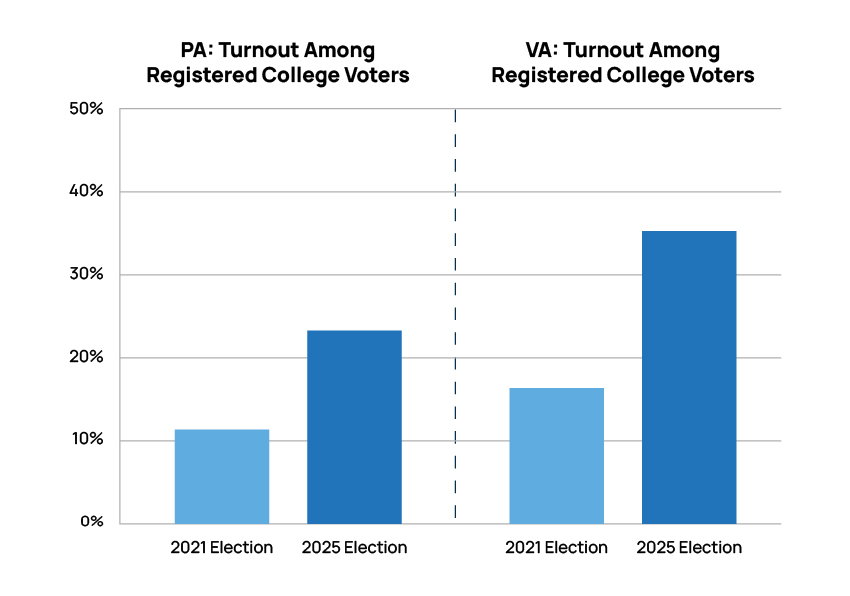
Registered student turnout increased sharply in both states studied. In Virginia, turnout among registered students at identified campus precincts rose 19 percentage points from the 2021 gubernatorial election. In Pennsylvania, it rose 12 percentage points from the 2021 Supreme Court retention election.
Similar increases in youth turnout were observed in New Jersey, where CIRCLE found an 8pp rise among 18-29 year olds compared to 2021.
In Virginia campus precincts, Abigail Spanberger received 87.9% of the vote, an 18pp gain over Terry McAuliffe's 69.9% in the 2021 gubernatorial election, and an 8.7pp gain over Kamala Harris's 79.2% in the same precincts in 2024.

Exit poll data from other 2025 elections showed similar trends. In New Jersey, Mikie Sherrill won 18-29-year-old voters by 35pp, a 32-point increase from Harris's support in 2024. In California, 18-24-year-olds supported Prop 50 by a wider margin than any other age demographic, according to NBC Exit Polls.
4.1 Top Issues: Survey respondents identified protecting democracy and the state of the economy as their top two priorities in 2025. Abortion and reproductive rights, and healthcare costs followed. This represents a notable shift from 2024, when the economy and reproductive rights led.
4.2 Economy: On the economy, students were more pessimistic about the overall economy than about their personal finances. Their primary economic concerns were immediate and tangible: housing costs, job prospects, and student loans. Students felt that neither major political party adequately addressed their economic concerns, though the Republican Party fared worse on this measure than the Democratic Party.
4.3 Immigration: Students expressed strong disapproval of the Trump administration's handling of immigration (66% disapprove, 56% strongly), with disapproval consistent across gender and race.
4.4 Federal DEI Intervention: Slightly over half of students reported feeling no personal impact from federal DEI intervention, while just under 40% reported a negative effect.
4.5 Gender Differences: Female students had a broader range of key issue concerns, including abortion and reproductive rights, and gun violence prevention. Male students were more narrowly focused on democracy and the economy.
4.6 Insights From Organizers: Campus organizers reinforced these survey findings. They reported that students were most effectively moved by messages tied to local, specific economic pressures, not national headlines or macro-level indicators. The most dependable path from apathy to a plan to vote, organizers said, was tying a student's vote to a local issue they could feel directly.
Student surveys conducted across battleground states in September and October 2025 found that students held a substantially more favorable view of the Democratic Party than the Republican Party, with the gap widening from September to October.

Respondents were asked to rate both parties across seven dimensions of party image. Democrats outperformed Republicans on all seven by October, including trustworthiness, effectiveness, relatability, and reasonableness. Students rated trustworthiness and efficacy as the most important attributes in their ideal political candidate. Female students held more favorable views of the Democratic Party across all measured dimensions. Male students rated the Republican Party more favorably than female students on measures of reasonableness, relatability, and morality.
6.1 Why Democrats Gained Ground: Campus organizers in 2025 were consistent in their diagnosis of why Democrats gained ground with students: opposition to Trump, not enthusiasm for Democrats. Nearly 87% of organizers attributed increased support to frustration with the Trump administration; 78% credited messaging focused on student issues and affordability. Among students who did not support Democrats, organizers reported that these students tended to view both parties as indistinguishable or elections as low-stakes.

6.2 Keys to Success: Organizers identified three keys to their success in 2025: (1) building feedback loops that systematically pulled learnings from the ground into messaging; (2) hiring and training senior and mid-level staff early; and (3) candidates who showed up on campus and demonstrated a genuine understanding of student concerns.
6.3 Barriers to Success: Three barriers were also consistently cited: (1) organizations working on the same campuses without coordination; (2) lack of Gen Z-specific research; and (3) uncertainty among both students and program staff about what the Democratic Party actually stands for.

On this page
Headings

.avif)

%202.svg)