.svg)
View all articles
Politics
A targeted omnichannel campus media program in Ohio shifted student awareness of birth control as an electoral issue and drove a 9.6-point increase in vote likelihood among exposed students.
Analysis and data collection conducted by flytedesk.
March 30, 2026
Lorem ipsum dolor sit amet, consectetur adipiscing elit. Suspendisse varius enim in eros elementum tristique. Duis cursus, mi quis viverra ornare, eros dolor interdum nulla, ut commodo diam libero vitae erat. Aenean faucibus nibh et justo cursus id rutrum lorem imperdiet. Nunc ut sem vitae risus tristique posuere.

A campus media program run during the 2024 general election cycle tested whether issue-based persuasion messaging could change how college students understood the electoral stakes around contraception access and whether that shift would translate into higher turnout intent.
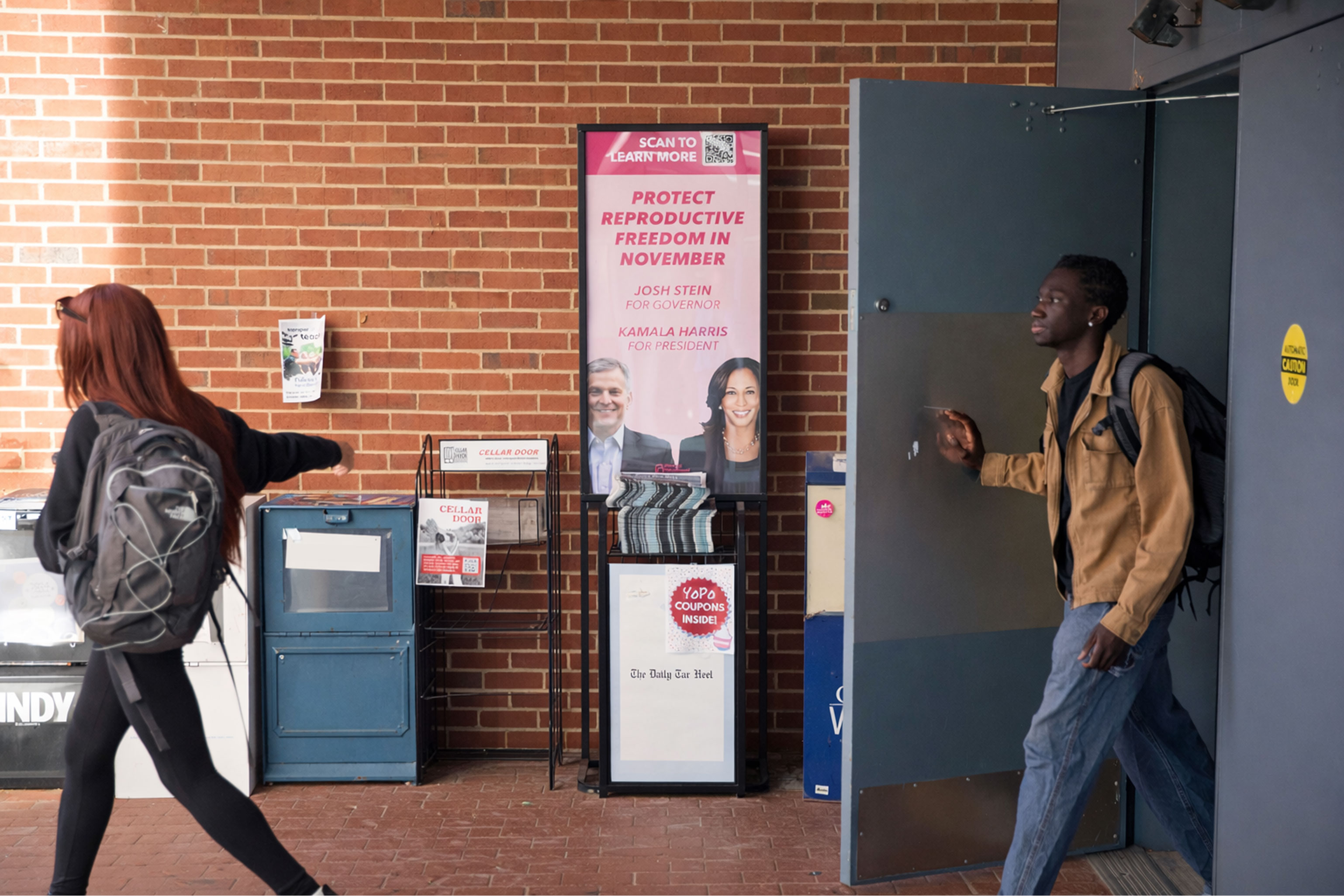
The campaign blanketed Ohio campuses with omnichannel content educating students on the legal similarities between contraception and abortion, and informing them that contraceptive access was at stake in the upcoming election.
Media ran simultaneously across multiple formats: out-of-home placements (digital screens, posters, transit), campus newspapers, email newsletters, SMS, student influencers, and digital advertising. Three campuses received active media; three comparable Ohio campuses served as controls with no program activity.
flytedesk fielded a survey three weeks into the four-week campaign. Responses were collected via SMS link across exposed and control campuses, yielding 525 total respondents. The survey measured vote likelihood, personal relevance of birth control as an issue, and perceived electoral impact of contraception access.

The most important shift produced by the campaign was informational. At control campuses, 19.4% of students incorrectly believed the election would have no impact on birth control access. At exposed campuses, that figure dropped to 9.9%, cutting the misconception nearly in half.
Exposed students were also 8pp more likely overall to say the election's results would affect birth control access (74.7% vs. 66.7%).
Exposed students were 6.3pp more likely to consider birth control a personally relevant issue (81.2% vs. 74.9%). Support for the legal right to access contraception was high across both groups, but meaningfully higher at exposed campuses (94.9% vs. 89.2%).
Students at exposed campuses were 9.6pp more likely to report that they planned to vote (96.4% vs. 86.8%). A midstream analysis confirmed a 10.7pp lift in students reporting they were "somewhat likely" or "very likely" to vote at exposed schools compared to control schools.
The data also showed a direct relationship between perceived electoral stakes and turnout intent: students who believed birth control access was highly impacted by the election reported voting likelihood of 84.2%, compared to 73.2% among those who believed it was not at all impacted.
Support for contraception access and its role as a voting motivator showed meaningful gender differences. Among women, 93.6% supported the right to access contraception and 91.1% said they would be more likely to vote if they believed it would make a difference in protecting that right. Among men, those figures were 87.6% and 74.6% respectively. Both groups showed majority support, but the issue was a stronger mobilizer among women.
Persuasion requires closing the awareness gap, not just reinforcing values. High baseline support for an issue does not guarantee turnout. The program worked because it identified a specific misconception (that contraceptive access was not politically vulnerable )and corrected it at scale.
Contraception access is a motivating issue for both genders. While women responded more strongly — 91.1% said they would be more likely to vote to protect contraception access vs. 74.6% of men — majorities of both groups said protecting this right would motivate them to vote. Campaigns should not treat this as a single-gender issue.
College students in 2024 already believed in the right to contraception. What many lacked was the understanding that this right had electoral stakes. The program worked not by reminding already-motivated voters to show up, but by changing what students understood to be true about an issue they already cared about. That informational shift, from passive support to active awareness of political vulnerability, drove the downstream lift in vote likelihood. The relationship between perceived stakes and turnout intent makes this clear: students who came to believe birth control access was highly impacted by the election were the most likely to vote.
For organizations working on issue-based persuasion among college students, the findings point to a clear strategic principle: identify what your audience doesn't know, not just what they already believe, and build your campus program around closing that gap.

On this page
Headings

.avif)

%202.svg)