.svg)
View all articles
Student behavior
Prepared by flytedesk, February 2026
March 26, 2026
Lorem ipsum dolor sit amet, consectetur adipiscing elit. Suspendisse varius enim in eros elementum tristique. Duis cursus, mi quis viverra ornare, eros dolor interdum nulla, ut commodo diam libero vitae erat. Aenean faucibus nibh et justo cursus id rutrum lorem imperdiet. Nunc ut sem vitae risus tristique posuere.

College campuses represent a rare media environment in contemporary advertising: a geographically constrained setting where a defined audience repeatedly encounters the same messages, often in the presence of peers. This paper outlines a theory of campus media planning grounded in cohort effects, habit formation, and social reinforcement. We argue that effective campus advertising depends not simply on the number of impressions delivered, but on their distribution across time, space, and social context within a bounded community. The paper introduces a conceptual framework for media mix design and measurement, and describes how campaign strength is evaluated through an internal modeling system, the outputs of which are surfaced to media buyers through a Campus Saturation Index.
Media planning frameworks are typically designed for open systems: national or regional audiences that move freely across geographies, platforms, and social contexts. College campuses, by contrast, represent a bounded or semi-bounded media system. Students live, study, socialize, and consume media within a highly constrained geographic area, often alongside the same peers each day. This spatial and social concentration fundamentally alters how advertising is encountered, discussed, and internalized. In this sense, the campus represents one of the few media settings where physical, digital, and social exposure can converge on the same cohort, making a full-funnel advertising strategy genuinely achievable rather than aspirational.
This document sets out a theory of campus media planning that treats the campus not merely as a collection of impressions, but as an impression integration environment: one in which the advertiser’s goal to reach the right audience, with the right message, at the right time becomes structurally available rather than probabilistic. The aim is not to propose a novel advertising metric for its own sake, but to clarify how and why certain planning decisions produce meaningful presence on campus while others do not. The analysis prioritizes explanation over prescription, and seeks to make explicit the assumptions that often remain implicit in campus media buying.
College students experience media in close proximity to their peers. Unlike most adult audiences, students frequently encounter advertising in shared physical spaces: walking to class, sitting in dining halls, studying in libraries, or waiting in common areas. These shared encounters increase the likelihood that media will be noticed, discussed, and socially reinforced.
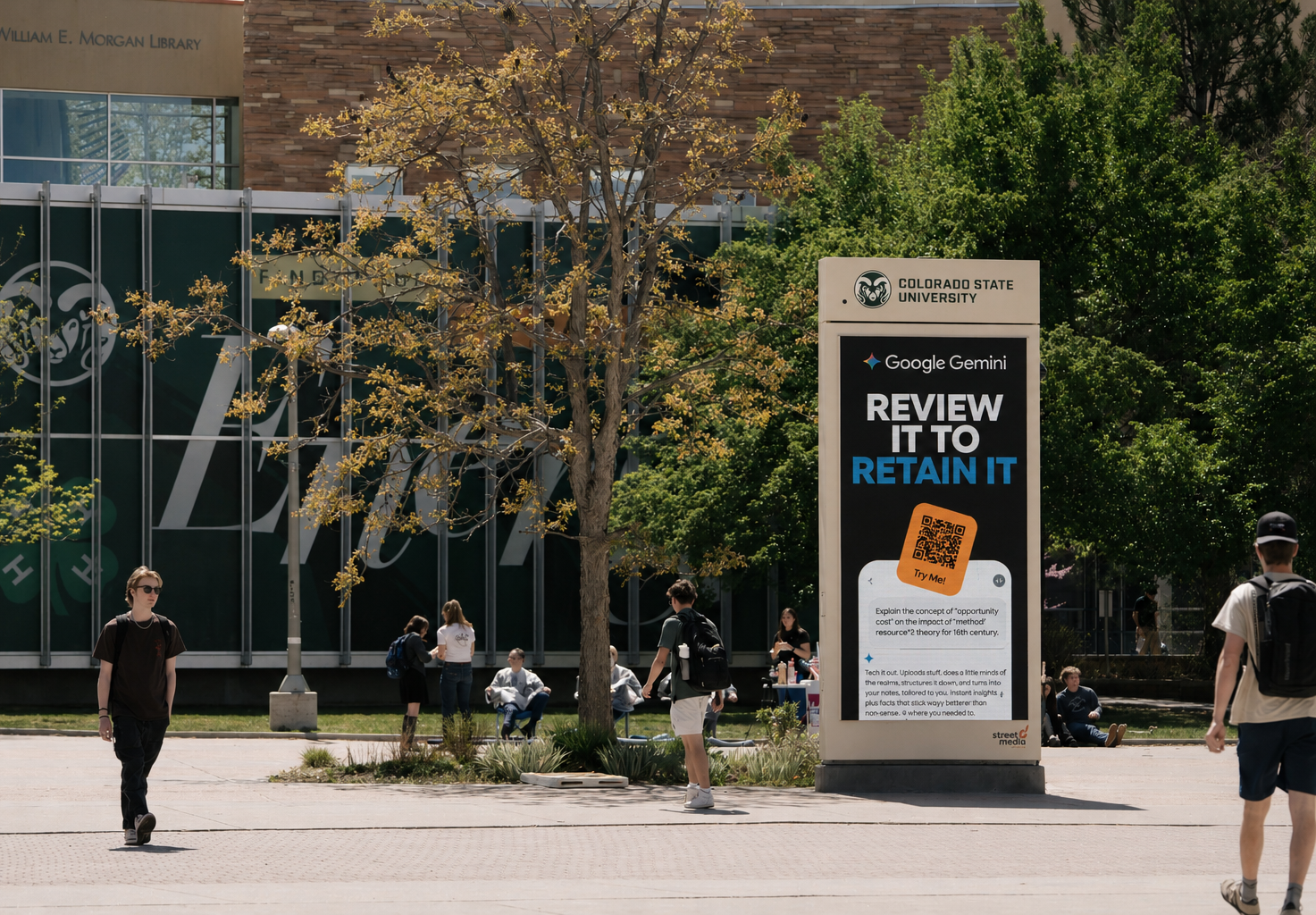
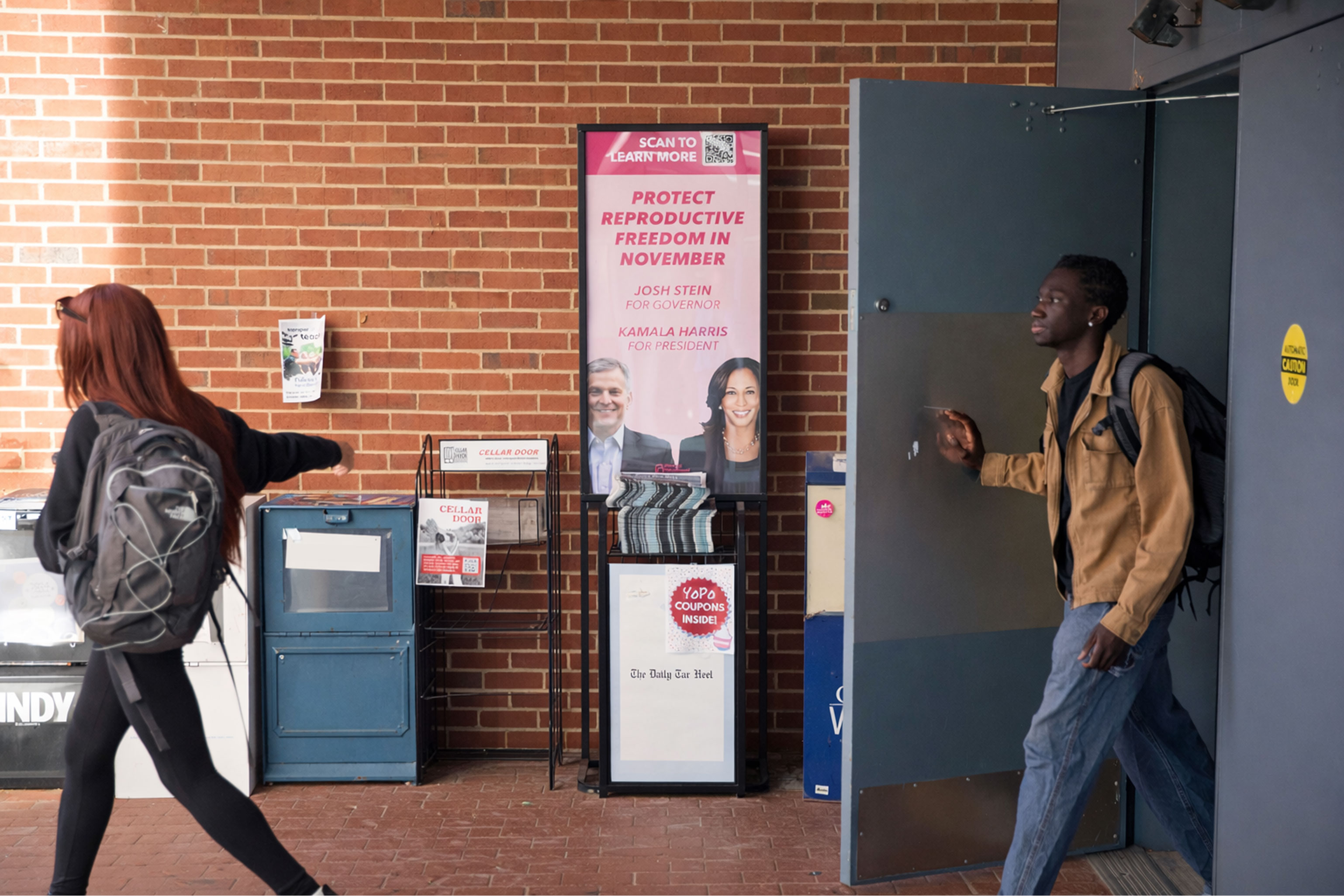
This dynamic aligns with long-standing findings in communication research that social context shapes media effects. Messages encountered in group settings are more likely to be recalled and evaluated through social cues. On campus, advertising is rarely a solitary experience, particularly for physical formats such as out-of-home placements, posters, and print ads that occupy the shared spaces students move through every day.
College is also a period of formative decision-making. Many students are developing independent preferences for brands, services, and civic participation for the first time. These decisions are not made in isolation; they are embedded in daily routines and peer norms. Media encountered repeatedly during this period can play a role in normalizing behaviors and shaping long-term preferences.
The implications for planning are significant. Campaigns should not expect immediate action from a single exposure, particularly when the call to action involves a complex or consequential decision. Instead, effectiveness depends on saturation: sustained presence across time and context.
From a measurement perspective, campuses are unusually tractable environments. The audience is geographically bounded, and exposure to offline media is less diffuse than in citywide or regional contexts. This constraint both reduces waste in targeting and enables measurement of campaign effectiveness, defined here as the correlation between sustained media presence, cross-format exposure, and the behavioral outcomes a campaign is designed to produce. Physical media is notoriously difficult to measure – impressions and dwell time can be modeled, but following up with the audience to track behavior or sentiment shifts is a steep challenge. The constrained geography of the college campus solves for this.
Marketers frequently invoke the idea of “surround sound” media: reaching the same target audience multiple times, across different channels, in ways that reinforce one another. In practice, this is difficult to verify in most media environments. Fragmented geographies, platform silos, and probabilistic targeting make it challenging to know whether different formats are actually reaching the same individuals.
On a college campus, this problem is materially different. Because students move through the same limited set of physical spaces each day, and because many campus media formats are persistent rather than ephemeral, it is possible to design campaigns with a high degree of confidence that the same audience is being exposed repeatedly through multiple channels. This makes the concept of surround sound media not merely aspirational, but operational.
Traditional media planning often prioritizes reach: the number of unique individuals exposed at least once. While reach remains relevant on campus, it is insufficient as a guiding principle. The characteristics of the campus environment described above – fixed geography, persistent formats, and co-present audiences – shift the central planning question from exposure to saturation: whether a campaign achieves enough presence to feel recognizable within the community.
Below a certain threshold, media may technically reach students without becoming salient, lost within the volume of platform-mediated content where even frequent exposures fail to register as meaningful. Above that threshold, messages begin to feel familiar, legitimate, and socially visible. This threshold varies by objective, but the underlying dynamic is consistent.
Three principles follow from this view:
Media mix decisions on campus should be understood as reflections of campaign goals rather than fixed formulas. Awareness-oriented programs tend to prioritize formats that are difficult to ignore and encountered repeatedly in daily routines. Performance-oriented programs emphasize channels that allow direct action, but still rely on visible media to establish legitimacy and recall.
In practice, effective campus plans combine channels that prime audiences with those that enable response. This is particularly important when the desired action involves effort or deliberation, such as voter registration or high-consideration purchases.
Sample media mix allocations by goal can be found in the table below. While a plan’s media mix is ultimately shaped by goals, budget, and media availability at target schools, the framework below reflects our channel prioritization when building a program.

To assess whether a campus plan is sufficiently powered, we employ an internal modeling framework that standardizes media inputs across channels. The purpose of this framework is diagnostic rather than predictive: it is designed to evaluate whether a proposed set of placements could achieve meaningful presence within a campus environment.
At the core of this framework is an internal metric we refer to as Campus Rating Points (CRPs). CRPs are used exclusively for planning and evaluation and are not reported as campaign outcomes. They provide a common scale for comparing heterogeneous media formats by translating them into a measure of campus-level media saturation.
Conceptually, CRPs reflect three components: (1) the size of the campus audience, (2) the characteristics of each media channel (including format visibility and social context), and (3) the volume and duration of exposure. Formally, CRPs are calculated at the campus level as the sum of channel-specific contributions, normalized by enrollment:
CRP_campus = Σ_m ( Exposure_campus,m / Enrollment_campus × Weight_m )
Where Exposure represents the estimated number of students reached by a given channel over a defined period, Weight reflects the relative quality of each channel’s impressions across four dimensions: visual impact (how likely the format is to capture attention), invasiveness (how difficult it is for a student to bypass or ignore), persistence (whether students are likely to encounter the same ad unit repeatedly over time), and social context (whether the format is typically encountered with peers or alone). The variable m indexes individual media channels included in the plan.
The resulting value provides a standardized indication of how saturated a campus is likely to be under a given plan. The ranges below reflect typical weekly CRP levels observed across campaigns and serve as planning benchmarks rather than performance guarantees. Note that target CRP ranges vary by campaign objective, but the underlying inputs and calculation remain consistent.
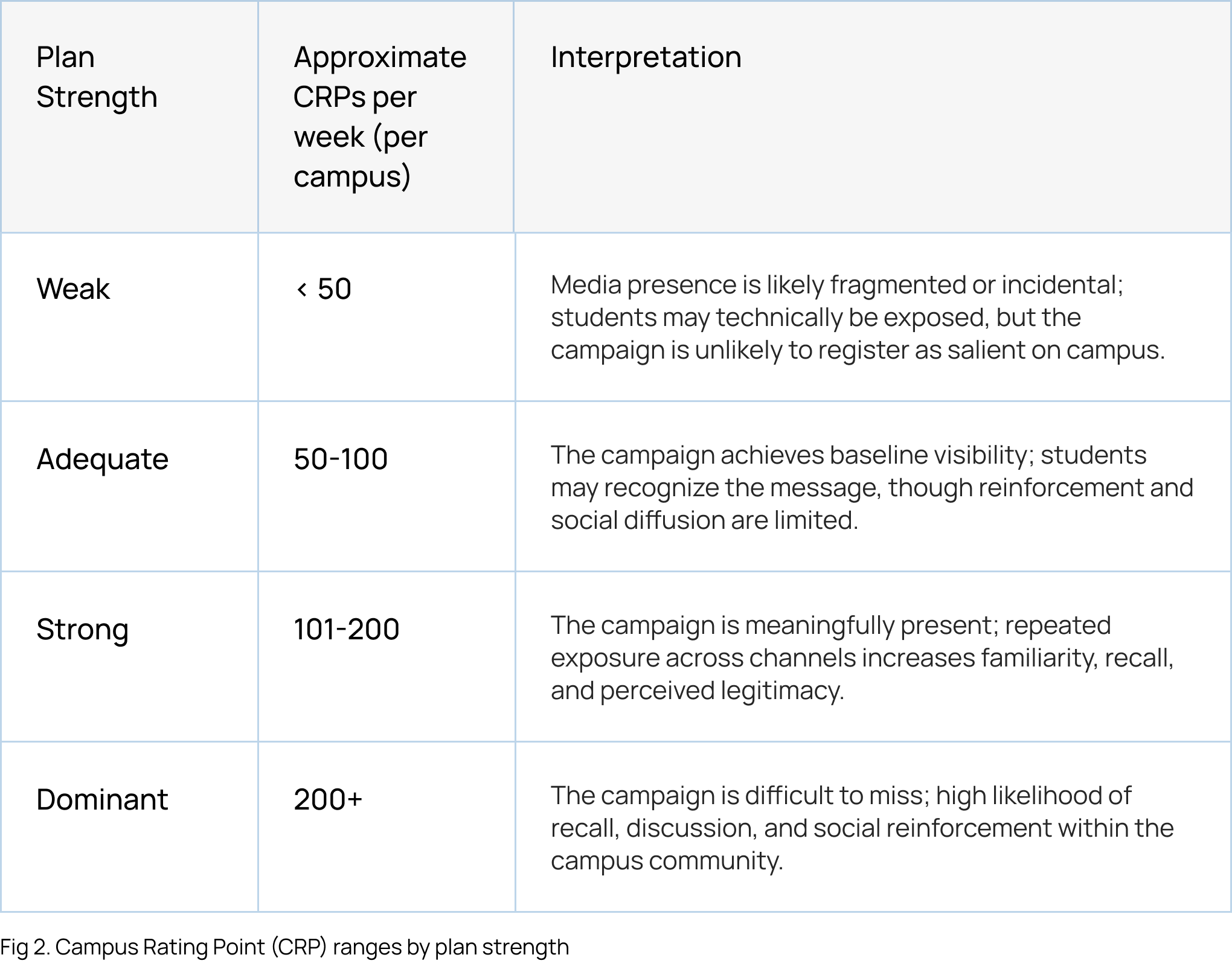
CRPs allow planners to evaluate disparate media mixes on a common scale, identify underpowered campuses, and assess tradeoffs between concentration, duration, and channel selection. While the metric itself is not client-facing on individual plans, we describe it here to make the internal planning logic transparent and to minimize reliance on black-box optimization.
The Campus Saturation Index (CSI) is the client-facing output of the CRP framework. It translates CRP ranges into four plain-language categories — weak, adequate, strong, or dominant — calibrated against campaign objectives and flight duration, without requiring buyers to engage with the underlying calculation.
The Index is intended to support planning conversations, not replace familiar buying metrics. Budgets, dollars per student, and visible share of inventory remain central to decision-making; the Index contextualizes those inputs within the broader campus environment.
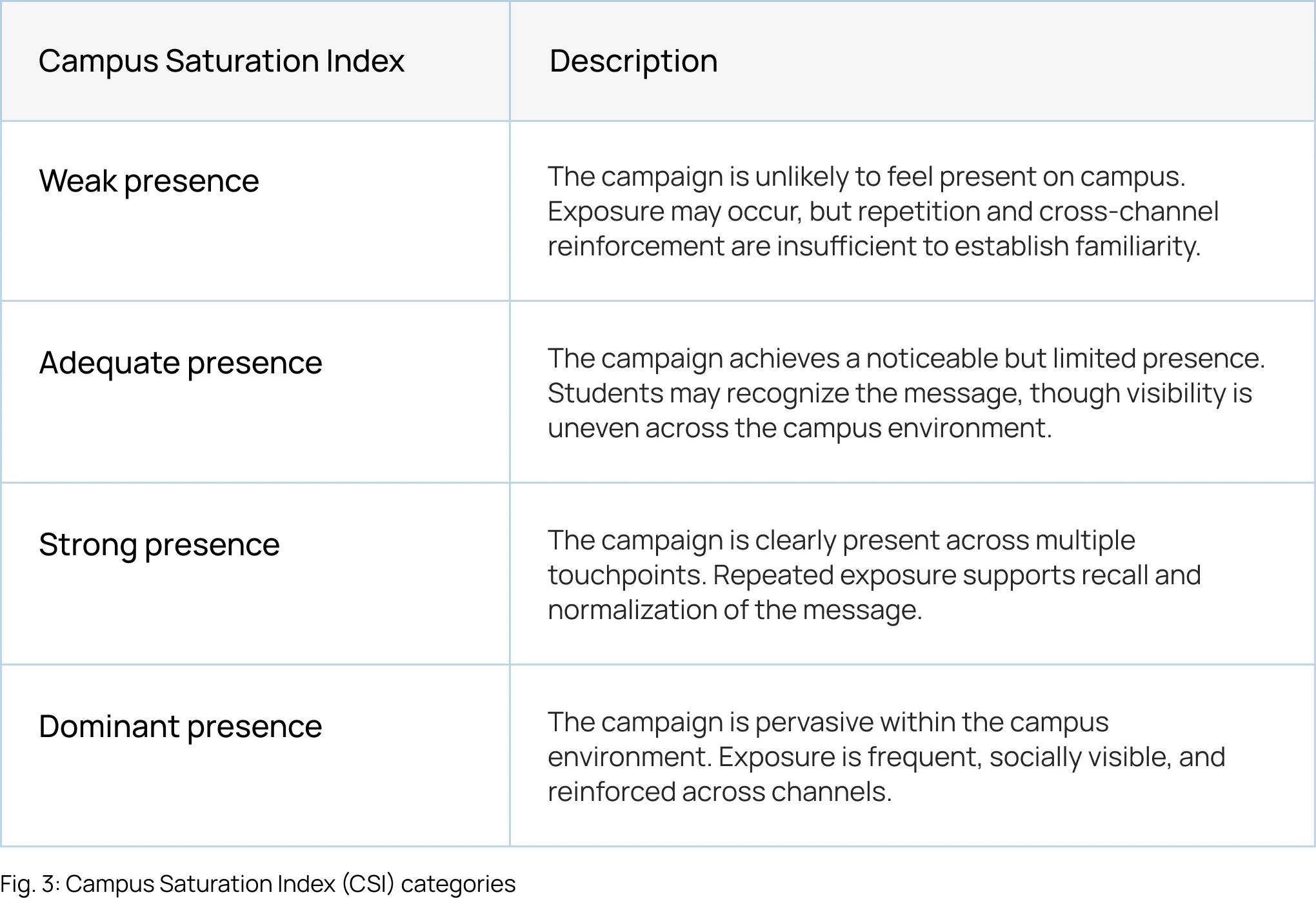
Several implications follow from this framework. First, underpowered plans are common when budgets are spread thinly across many campuses. Second, physical media often contributes disproportionately to perceived presence, particularly at lower investment levels. Out-of-home, posters, and print placements tend to function as environmental signals, received by students as part of the campus landscape rather than targeted content. Physical formats operate at the level of community presence; digital formats operate at the level of individual relevance. Effective plans rely on both, but physical media often establishes the foundation of visibility that makes other formats more effective. Third, short flights can undermine otherwise reasonable plans by failing to allow exposure to compound: early exposures establish recognition; later ones convert that familiarity into recall, social expectation, and diffusion.
These dynamics are not unique to any single category. They have been observed across brand and civic campaigns, though the level of saturation required to be effective varies by goal. Awareness objectives generally benefit from extended duration at moderate weekly intensity. Performance objectives can function at lower thresholds, but tend to be more fragile without the baseline credibility that physical media provides. Civic campaigns require sufficient frequency to normalize the intended action, with concentrated presence as key deadlines approach.
College campuses offer a rare opportunity to reach a defined audience within a constrained and socially connected environment. Doing so effectively requires a shift in planning logic: from maximizing impressions to achieving sufficient saturation.
By treating campus media as an impression integration environment rather than a collection of placements, and by evaluating plans in aggregate rather than channel by channel, it is possible to design programs that are not only efficient but effective. The framework outlined here seeks to make that logic explicit, providing a shared basis for planning, evaluation, and discussion.
¹See Pozharliev, R., Verbeke, W.J.M.I., & Bagozzi, R.P. (2017). Social consumer neuroscience: Neurophysiological measures of advertising effectiveness in a social context. Journal of Advertising, 46(3), 351–362. Using neurophysiological measures, the study finds that shared viewing generates stronger emotional engagement and memory encoding than solo viewing, independent of ad content type. See also Coker, B. & Altobello, S. (2018). Product placements in social settings: The impact of coviewing on the recall of placed brands. Journal of Business Research, 89, 160–168, which finds that interactive peer coviewing settings specifically enhance brand recall relative to solo viewing.
²Solomon Partners / OAAA Benchmark Report (2023) estimates that OOH formats produce approximately 84-86% consumer ad recall – roughly double the rates observed for social advertising (46-57%). The same research notes that high-impact OOH placements function as amplifier formats, increasing attention to subsequent digital media in the mix.

On this page
Headings

.avif)

%202.svg)