.svg)
View all articles
Case studies
A four-group matched-market experiment shows that adding sustained on-campus media to digital outreach produces disproportionately stronger student usage and revenue outcomes than digital alone.
March 30, 2026
Lorem ipsum dolor sit amet, consectetur adipiscing elit. Suspendisse varius enim in eros elementum tristique. Duis cursus, mi quis viverra ornare, eros dolor interdum nulla, ut commodo diam libero vitae erat. Aenean faucibus nibh et justo cursus id rutrum lorem imperdiet. Nunc ut sem vitae risus tristique posuere.

A matched-market field experiment conducted during the back-to-school period tested how varying levels of campus media investment influence real-world outcomes for a leading digital learning platform.
Campuses were assigned to four treatment conditions ranging from digital-only exposure to high-intensity on-campus saturation. Across usage, perceived popularity, feature awareness, and subscription indicators, outcomes improved systematically with treatment intensity.
The central finding: allocating a portion of a college marketing budget to sustained, visible campus media produced disproportionately large gains relative to digital-only exposure. The results suggest that campus presence functions as a force multiplier rather than simply another channel.
Back-to-school represents a critical period when students adopt tools, establish routines, and form preferences that often persist throughout the academic year.
For the client in this study – a widely used academic platform with strong baseline awareness – the question was not whether marketing could introduce the product. Instead, the experiment sought to isolate the incremental impact of campus visibility within an already competitive media environment.
Specifically: Does adding on-campus media meaningfully change behavior when students are already exposed to digital channels?
The study used a quasi-experimental matched-market design. Institutions were grouped by size, region, and student characteristics, then assigned to one of four treatment conditions.
Group A: High-Intensity Campus + Digital
Multi-format on-campus media layered onto major digital platforms.
Group B: Moderate Campus + Digital
Limited campus formats plus the same digital support.
Group C: Digital-Only
Exposure through major off-campus platforms without physical presence.
Group D: Control
No paid media.
This structure enabled directional comparisons of incremental impact as campus investment increased.
The analysis integrates multiple measurement streams:
Recent product use was highest in the high-intensity campus condition and lowest in digital-only and control environments.
Students exposed to messages on campus as well as on major digital platforms were most likely to report active use during the academic term.
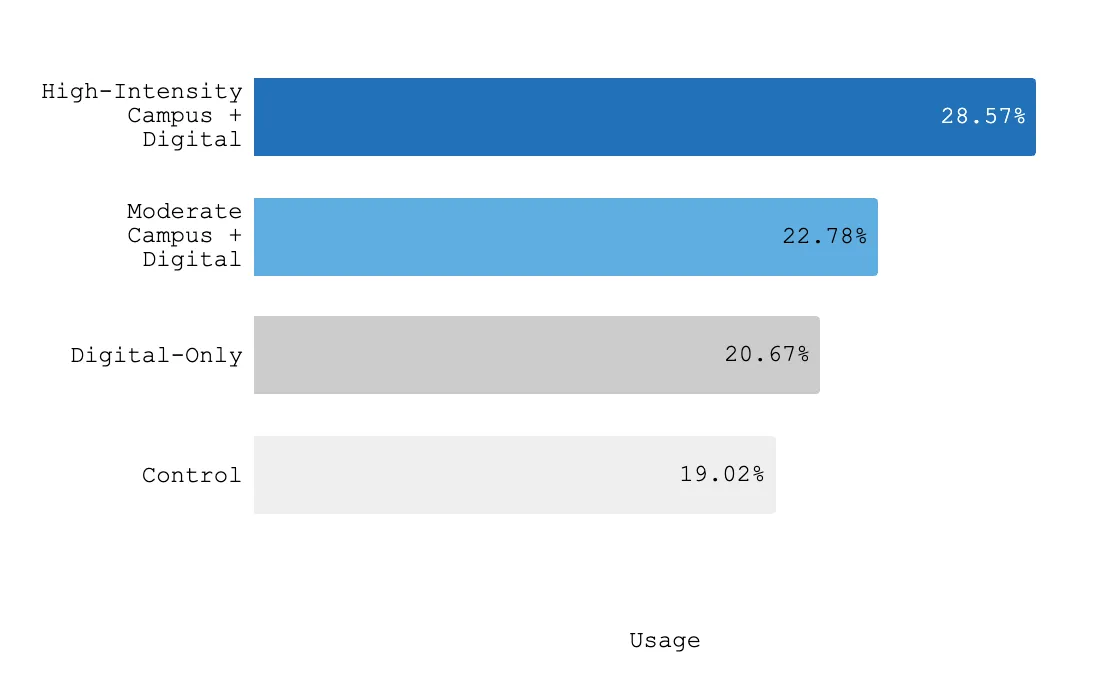
While usage rose seasonally across all groups, the relative differences suggest that campus presence amplified demand beyond baseline back-to-school effects.
3.2 Perceived Peer Adoption Responded to Campus Visibility
Belief that the product was popular among classmates strengthened as treatment intensity increased.
High-exposure campuses reported the strongest perception that peers were using the platform, while digital-only environments lagged.
Because students frequently choose tools collaboratively, perceived popularity can influence adoption independently of personal attitudes.
Feature-level awareness, not just brand recognition, was higher in groups receiving on-campus media.
Additional visibility appeared to help students associate newer capabilities with the core product, suggesting that physical presence reinforces understanding as well as recall.
Students at high-intensity campuses were somewhat more likely to report having ever used a paid version of the product.
Although subscription uptake was not the primary objective and absolute differences were modest, the pattern was consistent across treatment tiers.
Across all measured indicators, improvements were not proportional to reach alone.
Moving from digital-only exposure to moderate campus presence produced meaningful gains, while the highest-intensity treatment delivered the strongest results across nearly every metric.
Campaign analysis concluded that layering additional on-campus media produced better outcomes than comparable investment confined to digital channels.
The experiment suggests that campus media operates differently from diffuse advertising channels. Several mechanisms likely contribute to the nonlinear response:
Concentrated Exposure
In bounded environments, repeated encounters accumulate quickly, creating high effective frequency.
Social Visibility
Public placements signal that a brand is widely seen, shaping perceived norms.
Contextual Relevance
Messages appear in academic settings where the product’s use case is immediate.
Multiple Response Pathways
Students may act later, offline, or through direct navigation rather than trackable clicks.
Together, these dynamics can produce effects disproportionate to budget share.
From a planning perspective, the results suggest that campus media should not be evaluated solely on reach or cost efficiency. Instead, its value lies in its ability to amplify the performance of broader marketing efforts within specific communities.
Key implication: Reallocating a portion of a college marketing budget toward sustained campus presence may generate outsized commercial impact relative to its proportional spend.
Digital channels remained important across all treatment groups, but outcomes were strongest when those channels were anchored by visible on-campus activity.
This matched-market experiment demonstrates that campus media can produce measurable incremental impact when layered onto existing marketing programs.
The findings indicate that effectiveness on college campuses depends not only on exposure but on concentration within the environments students share daily.
In that context, campus presence functions less as a supplementary tactic and more as a catalyst – transforming baseline awareness into active use and engagement.

On this page
Headings

.avif)

%202.svg)